Stand-Up Paddleboard Safety Tips
Stand-up Paddleboarding (SUP) has become hugely popular over the last decade, and as inflatable paddleboards have become cheaper, more and more people are purchasing their own. As with any activity in a dynamic marine setting, being equipped and prepared with the right kit and knowledge is essential for staying safe and having fun.
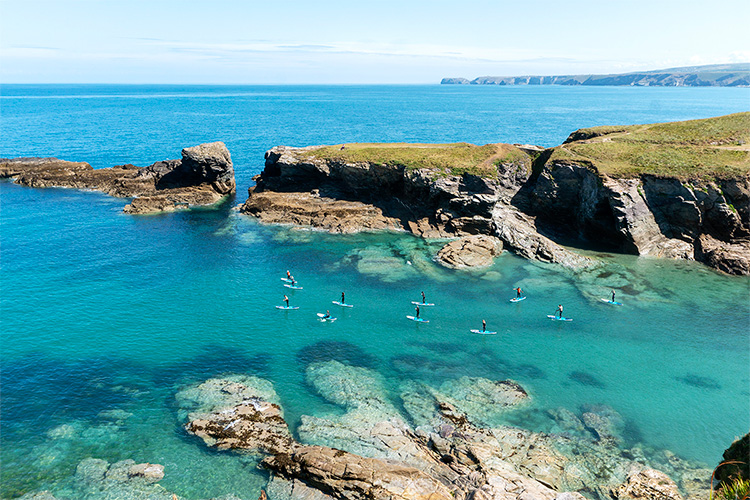
A group heading out on a guided SUP session from Port Gaverne
We run guided SUP sessions and hire out inflatable paddleboards (as well as running BCAB Paddlesport Safety & Rescue courses), providing all of the necessary safety equipment and delivering a thorough safety briefing to all of our customers, including setting boundaries and areas for where hired equipment can be taken depending upon the sea state and weather conditions. Because so many people now own their own inflatable paddleboards, we want to share our advice for staying safe so that if you are paddleboarding anywhere else this summer you can be prepared and take the right precautions.
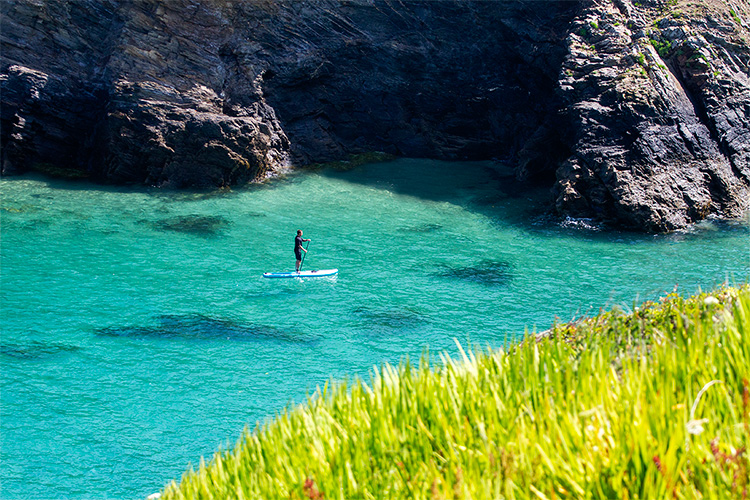
We also offer equipment hire on our top-of-the-range kit
Be prepared. Before you take your own paddleboard out for the first time this summer, get it out and pump it up to full inflation (usually at least 12-15 PSI) in your garden and leave it for a few hours to make sure that it doesn’t have a slow puncture. The last thing you want is to be out on the water when you realise it is deflating.
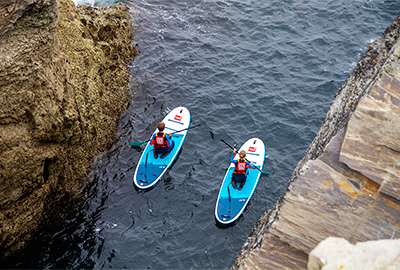
Correctly kitted up and taking it carefully through The Gut!
Check the weather and surf forecast – IN DETAIL. Looking at the day’s weather on the app on your phone will not tell you enough. Strong winds the previous day could have caused significant chop, even if it’s not windy now. A surf forecast will show you the swell height and period (in seconds) – a short swell period means waves that are close together, and choppy, whereas a long period means long gaps between swells but they can be bigger and more powerful – long period swells are generated by strong storms hundreds or thousands of miles away. If the wind is offshore (blowing from the land out to sea) or forecast to turn offshore whilst you’re out, don’t go out – an offshore wind can blow you out to sea or make it difficult to return to shore against the wind.
Plan your route, and check the tides. The rising and falling tide creates a tidal flow along the coastline, in one direction or the other (depending on whether the tide is rising or falling). In some places on the coast of the UK the tidal stream can be quite close to shore, carrying you in one direction which is great if you planned to go that way, and definitely not if you didn’t.
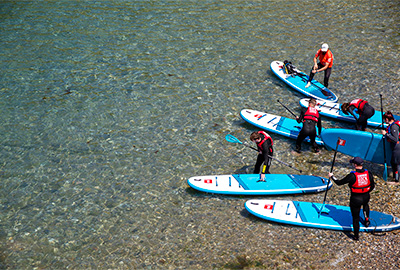
Buoyancy aids, coiled leashes, fully briefed and ready to have some fun!
Dress as though you are going to fall in. Because you probably will. On the coast, that means a wetsuit.
Wear a PFD (personal floatation device) or buoyancy aid. When on a session with one of our qualified guides, or when hiring from us, we provide you with a buoyancy aid to wear (in line with Paddle UK regulations). If you are heading out on your own SUP and are a capable paddleboarder and confident swimmer, you could consider a PFD that unpacks from a waist pack.
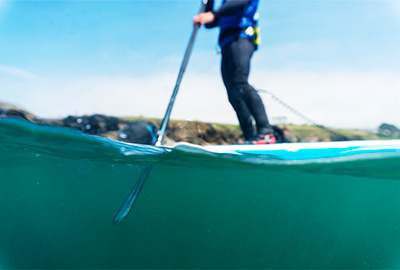
Coiled leashes stay out of your way!
Wear the right leash, to keep you connected to your paddleboard. In flat water or where the is low risk of your leash getting caught on anything, a straight ankle or calf leash is the one – ideally coiled to keep it out of your way. Straight leashes tend to be for the surf. In moving or flowing water where there is a risk of the leash being caught on something a leash with a quick-release waist belt is advised, so that you can detach yourself from the board quickly and easily should you need to.
Tell somebody where you are going, and what time you expect to be back.
Take your phone in a waterproof pouch or case. That way you have a means to call for assistance if you get into difficulties, and also to provide your location (we’d recommend downloading what3words).
If I doubt, don’t go out. That’s the long and the short of it. Overconfidence has been the precursor for a lot of rescues at sea, and it is best to respect the ocean and be mindful of your own abilities and how quickly conditions can change. We’d always recommend that you join us for a guided session if you are in any doubt, or if you want to have somebody else (us!) consider and take care of all of the above for you.