The UK’s Marine Heatwave
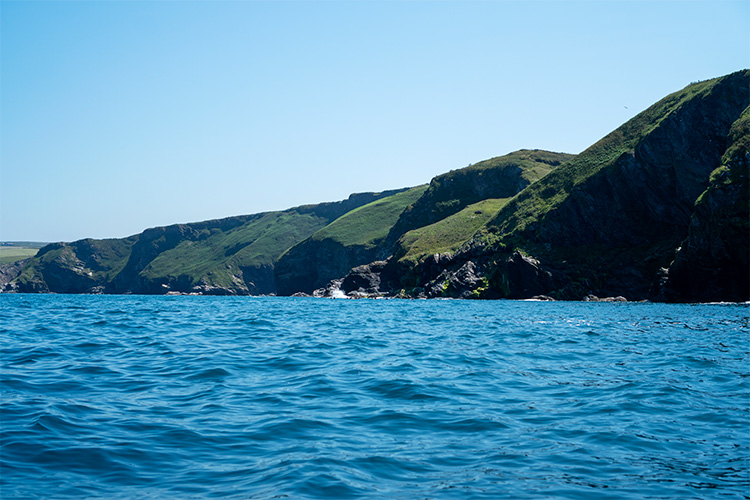
It may not feel it when you jump into the sea, but for the past two years the ocean around Cornwall has been experiencing an almost continual marine heatwave. So, what is a marine heatwave and what impact is it having?
What Is A Marine Heatwave?
A marine heatwave is different to the heatwaves on land that most of us are familiar with, although they can be connected and feed each other. A marine heatwave is defied as being when the sea surface temperature is in the top 10% of readings at that location for that day of the year for five consecutive days, based on satellite recordings of sea surface temperatures taken over 30 years between 1982 and 2012.
What Causes Marine Heatwaves?
Various factors such as weakening ocean currents or atmospheric conditions such as light winds reduce the mixing of warmer surface water with cooler water from deeper in the water column. Warmer water stays at the surface and is warmed further by the sun, creating a “heat lid” – warm water rises so when the top layer is unusually warm it cannot sink and mix until there is a change in oceanic or atmospheric conditions to force that mixing.
Since 1903 Plymouth Marine Laboratory and the Marine Biological Association have been monitoring conditions in the western English Channel using their E1 scientific buoy. E1 is sited twenty miles south of Plymouth in a depth of 80 meters, and records the temperature and salinity of the entire water column. They have recorded a long-term warming trend, as Professor Tim Smyth explains:
“The more than centennial dataset from the western English Channel shows that sea-surface temperatures have increased markedly within the past 40 years, at a rate of around 0.6°C per decade. Furthermore, warm anomalies have been increasingly common, and cold anomalies increasingly rare.”
As the ocean warms and as terrestrial heatwaves become more common, so will conditions where sea surface temperatures are within the 90th percentile. The ocean is believed to have absorbed 90% of the excess heat created by humans burning fossil fuels since the Industrial Revolutions, warming sea temperatures globally by around 1°C so far, meaning that it then does not take much to tip SST’s into marine heatwave conditions.
The Current Marine Heatwave Around The UK
Sea temperatures in Northwest European Waters in April and May hit record highs since satellite monitoring began in 1982. At the end of May the E1 buoy was recording sea surface temperatures 2 – 3 °C higher than average.
The unusually dry, calm and warm spring (the warmest on record) meant that the waters around the UK started warming a month earlier than usual, in February, after a mild winter.
April and May registered as “extreme” marine heatwaves. Right now, it is “significant”, as stronger westerly winds and cooler weather in the first half of June brought conditions back into the “normal” range in the Celtic Sea. Monthly seas surface temperatures have been about a month ahead of what they should have been, for most of this year so far. At the moment in mid-July the waters of the Celtic Sea off North Cornwall are approximately 1.5°C above the 1982 – 2012 average.
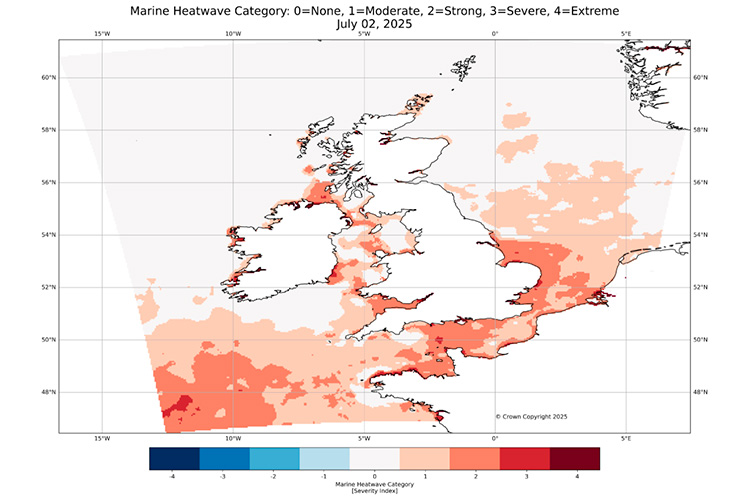
Met Office map of the UK marine heatwave, July 2nd 2025
These differences in the temperature of the sea are not always noticeable, particularly when the air temperature is particularly high as it has been recently, because the sea will naturally feel a lot colder than the air. In fact, it’s probably more noticeable on the cooler days!
What Are The Impacts of a Marine Heatwave?
The sea being a bit warmer might sound quite nice, but the reality is more concerning. The ocean is a major climate regulator, and often the cool ocean can help to reduce the severity of terrestrial/atmospheric heatwaves. Without a cool ocean breeze, heat waves on land can be more intense and the storms that result from the warm, wet air can be much more severe.
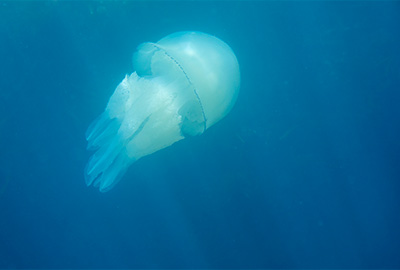 In the ocean itself, warmer surface waters can disrupt the delicate balance of the marine ecosystem. The heat can stress many of the species that live in the sea, particularly those with no or limited range such as molluscs (mussels, oysters and other shellfish that cannot move to cooler water) and seaweeds. Warmer waters also attract species that may not otherwise visit these waters or for so long – this year there has been a newsworthy “octopus bloom” around parts of Cornwall (mainly on the south coast) that is disrupting the crab and lobster fishery, and here on the north coast we have seen a lot more barrel jellyfish and they are here for much longer than usual. Some fish species such as Bluefin tuna and sea bass may also benefit from the warmer conditions. Whilst seeing all of these species in our waters can be amazing, it is not so great if they are not meant to be here at this time of year as it signals an imbalance in the marine ecosystem.
Marine heatwaves can also trigger algal blooms. This year the spring plankton bloom started and finished earlier, returning us to clear conditions but also potentially impacting the marine food web. Stronger algal blooms can poison shellfish and also make them unfit for human consumption. Warmer water does not absorb oxygen so well, and the reduced mixing of ocean waters means that oxygen can become trapped in surface layers whilst nutrients can be trapped near the seabed, leading to seabed hypoxia (low oxygen) and die-off events. Whilst we have not seen this around the UK, a marine heatwave around South Australia in a patch of ocean 5x the size of Australia itself has caused a die-off event with various species washing up dead on beaches.
What Does This All Mean?
For our activities, these persisting conditions that are at or close to marine heat wave status don’t mean very much. The warmer water is only slightly noticeable, but on really hot days the difference between air and sea temperatures means that the sea still feels quite cold! We’ve definitely seen a lot of those big, harmless barrel jellyfish around during sessions so far this summer, but no octopus or blue fin tuna – yet!

Our hope is that our generally cooler waters mean that the Celtic Sea and North Atlantic will be spared the worst impacts of these marine heatwaves, and that governments around the world can get a handle on greenhouse gas and CO2 emissions as quickly as possible to reduce the severity of climate breakdown, marine heatwaves included.