- News
- |
Making Cornish Rock Tors' 2024 Season Carbon Neutral & Ocean Positive
We care deeply about our ocean playground and Planet Ocean, and are committed to doing everything we can as a business to fight climate change. Since 2021, we’ve been measuring and mitigating our carbon emissions, while also giving back to the environment that supports us.
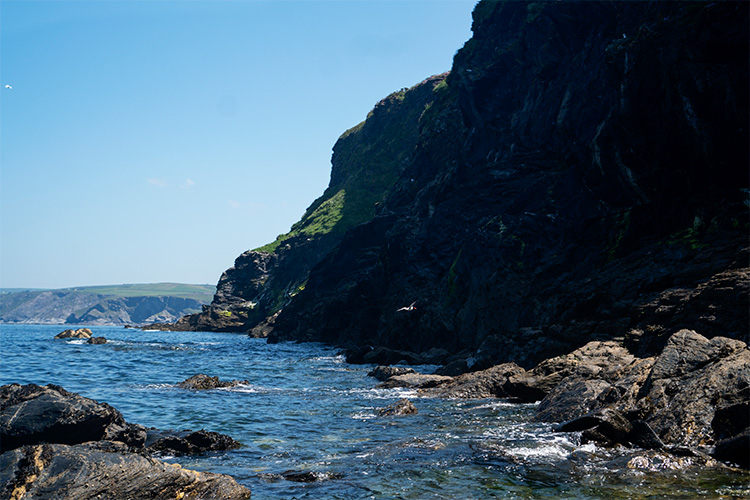
A Natural Playground
One of the most effective ways to drive positive change is by achieving carbon neutrality. To be considered carbon neutral, a business must offset its Scope 1 and 2 emissions. Scope 1 emissions refer to those directly caused by a business’s activities (such as from a central heating boiler or company vehicle emissions) whilst Scope 2 refers to indirect emissions (such as those created by the use of electricity from fossil fuel power stations, for example). Scope 3 emissions are those created within our supply chain. To achieve Net Zero, a business must fully account for Scope 3 emissions through certified programs and reduce its emissions in line with science-based targets in line with the 2015 Paris Agreement.
We are proud to share that Cornish Rock Tors has been carbon neutral since 2021, and in addition a significant proportion of our Scope 3 emissions are also accounted for. To go further, we’ve made a commitment to be ocean positive. Not only have we reduced our emissions and mitigated what remains, but we’ve also taken direct action to help the environment. For every year that we’ve measured and offset our carbon footprint, we’ve also made a donation double the cost of the offset to The Ocean Conservation Trust to support their vital work in protecting and restoring our oceans.
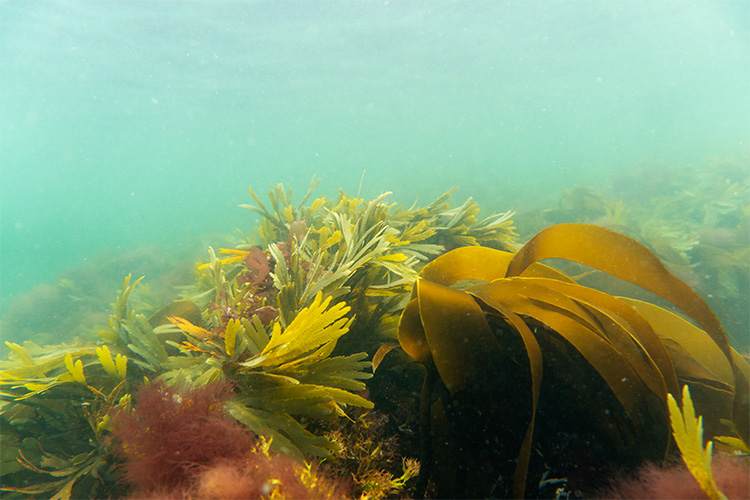
There’s a whole world under the water here in Cornwall
As a small business, we’ve focused on reducing, managing and mitigating what we can (Scope 1 & 2), minimising as many Scope 3 emissions as possible, and going beyond by supporting nature-based solutions. By being in business we want to ensure the planet is better off. You can learn more about our progress and what we did in 2024 to achieve this:
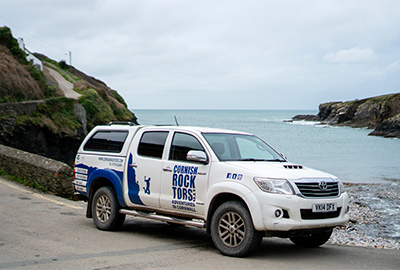
The only source of our Scope 1 emissions in 2024
Travel and Fuel Consumption (Scope 1)
From 2021 to 2023, we tracked our travel and fuel usage, considering Ben’s ten-mile return trip between his home and Port Gaverne in the company truck. Now, with Hugo having taken the helm in 2024, our data and footprint has changed because he lived further away. Below is the calculation for our season, which runs from Easter to the end of October Half Term (Note: this is an intentional over-estimation, as Hugo often travels in on his motorbike on good weather days in the summer!):
51.2 miles x 225 days in a 2014 Toyota Hilux = 5.29 metric tonnes of CO2e.
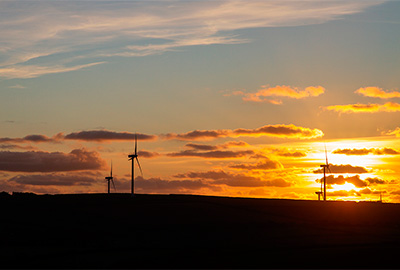
Renewable Energy
Energy Consumption (Scope 2)
Our energy is supplied through our landlord, The National Trust, which sources renewable electricity from Good Energy. Good Energy are the owners and operators of the nearby Delabole wind farm. Therefore, the carbon footprint of our electricity usage is presumed to be zero.
• The carbon footprint of our business energy = 0
Supply Chain Emissions (Scope 3)
Our website is hosted on renewable-energy-powered servers, as is our booking engine (Eola). We also use Google Workspace, which is powered by renewable energy and offsets its carbon footprint from the start. Our social media presence also has no carbon footprint, as Meta powers its servers with renewable energy.
• Carbon footprint of our online presence = 0
We’ve banked with The Co-operative Bank, a business that has been “beyond carbon-neutral” since 2007.
• Carbon footprint of our banking = 0
Cornish Rock Tors’ 2024 Carbon Footprint = 5.29 tonnes
Mitigated using a certified scheme with Climate Impact Partners.
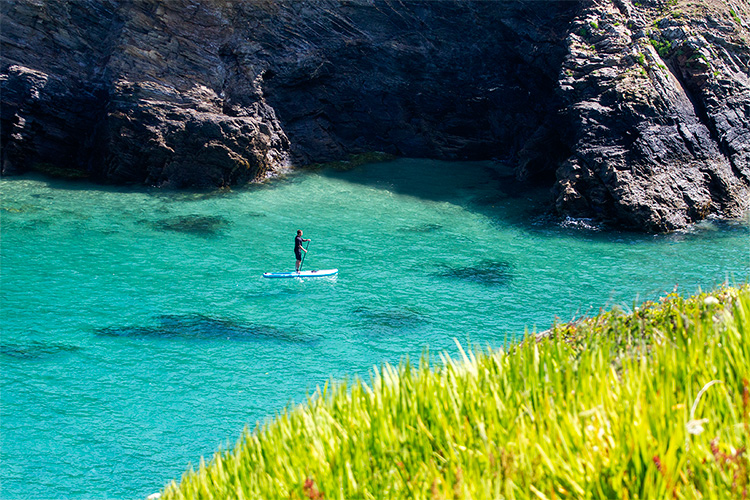
Blue and Green at Port Gaverne
Being Ocean Positive
Our goal is always more than just accounting for our carbon emissions—we wanted to make a difference to the environment that we work and play in. To that end, we’ve been donating to The Ocean Conservation Trust to support their ongoing efforts to protect and restore our oceans. For the past decade one of their major focus areas has been on seagrasses, some of the planet’s most valuable, biodiverse and carbon rich habitats. In the UK, nearly half of our seagrass beds have been lost since the 1930s and there are valuable seagrass habitats along the South Cornwall coast that need our protection. Seagrass absorbs carbon 35 times faster than tropical rainforests, storing it deep in the seabed for millennia. Despite covering only 0.2% of the seabed, seagrass meadows store 10% of the ocean’s carbon. These fragile, vital habitats stabilise the seabed, reduce coastal erosion, and provide key ecosystems and nursing habitats for juvenile fish. The Ocean Conservation Trust’s Blue Meadows project aims to protect, restore, and regenerate seagrass meadows across the Southwest coastline of the British Isles.
Each year, we strive to refine our process, increase our accuracy, reduce our carbon footprint, and give back as much as possible. We’re excited for what 2025 will bring and hope to inspire other businesses to join us on the journey toward carbon neutrality and Net Zero.