- News
- |
Cornish Rock Tors Carbon Neutral And Beyond 2021
The climate crisis is real, and urgent action is required at every level. That’s why we decided at the end of our 2021 season to assess and measure our carbon footprint for the year, and become a carbon neutral and regenerative business.
As a business working in and connecting people to the beauty of the natural world we believe that it’s our duty to protect it, and to take steps to restore it.
How Carbon Footprints Are Calculated
Formal carbon audits divide a business’ carbon footprint into three “scopes”, or categories. Scope 1 covers carbon dioxide or equivalent emissions generated directly by the business, by company vehicles, central heating boilers, air conditioning and so on. If you’ve ever stepped into our booking office on a cold day, you’ll know that we don’t have central heating – those old fish cellars were designed to be cold to keep the pilchards from spoiling, and cold they are! We do have a company truck that we needed to account for, however, and our boat. Scope 2 emissions is for electricity and gas utilities where they don’t come from renewable sources. Scope 3 covers the carbon footprint of a business’ supply chain or emissions generated post-delivery of a product, so can include things like employee’s travel to and from work and anything purchased for the business (Scope 3 can be incredibly complicated).
To qualify as being carbon neutral a business must cover, reduce and offset its Scope 1 and 2 emissions (covering Scope 3 emissions is encouraged), whilst becoming Net Zero requires them to cover all three scopes, reduce their emissions along a 1.5ᵒC trajectory, and offset remaining carbon through certified schemes that result in the sequestration of carbon from the atmosphere.
To make it a bit easier to understand (and for us to measure) we broke Cornish Rock Tors’ carbon footprint down into travel (Scope 1), energy use (Scope 2) and we then looked at several other areas of the business that have a carbon footprint that we could assess.
Travel (Scope 1)
Our company vehicle is a Toyota Hilux truck, that we use for towing kayaks and towing and launching/recovering our safety boat. Ben lives a few miles up the road, and so it does a round trip of exactly 10 miles each day when he drives it to and from Port Gaverne.
For the sake of argument, we’ve calculated 10 x 365 days. He doesn’t do that journey every day (because we’re not here and open every day through the winter), but we figured that overshoot would cover trips to Polzeath to our archery range, and other business related journeys. The carbon footprint of that mileage, in that vehicle, equates to 1.71 tonnes of CO2e.
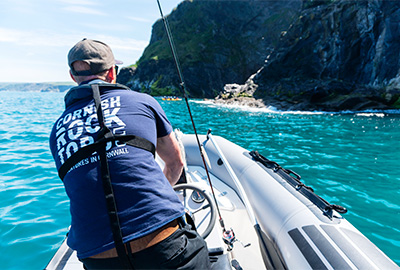
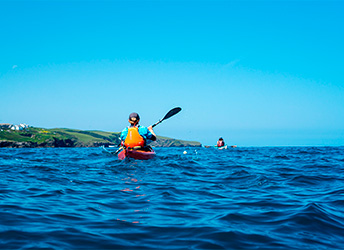
Checking in with sea kayaking groups up the coast.
Our safety boat is based at Port Gaverne and is used as a support craft for long distance open water swims, or in situations such as sudden and unexpected changes in conditions when we might have to quickly call in all equipment hire that is out on the water, or a couple of times a year for photo shoots. No two boats are the same and it is much more complicated to calculate the carbon footprint of a boat, other than to measure the number of liters of fuel used. We’ve estimated that we used no more than 60 liters of unleaded petrol in 2021 (several swim supports, one photo shoot and no safety incidences). The tonnes of CO2e from emissions per liter of unleaded fuel is 0.0239 (2.39kg), so we calculate the boat to contribute 143.4kg, or 0.1434 tons, towards the business’ carbon footprint.
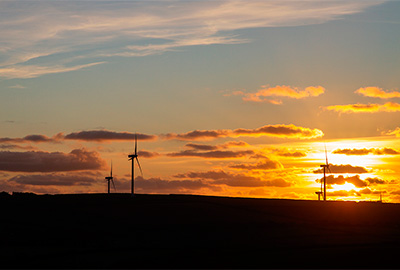
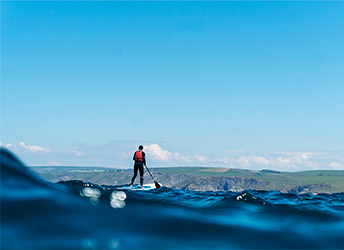
It can be windy where we are based. What a good way to use it!
Energy (Scope 2)
Our landlord is The National Trust. As a conservation charity they work to protect the environment and have addressed their energy use in recent years (they had a target to reduce their use of fossil fuels for heat and electricity across their properties by 50% by 2020 and will be Net Zero by 2030). The National Trust have a long standing partnership with renewable energy company Good Energy, who happen to own and operate the wind farm just five miles up the road from us at Delabole (which was the first commercial onshore wind farm in the UK when it was built in 1991). Therefore we understand that we are on a renewable electricity tariff with Good Energy, receiving power from the Delabole wind farm and as such our electricity has no carbon footprint.
There is no oil or gas fired central heating, or air conditioning, in our premises (the chance would be a fine thing!) so we have not had to consider emissions from those sources either.
Other Sources
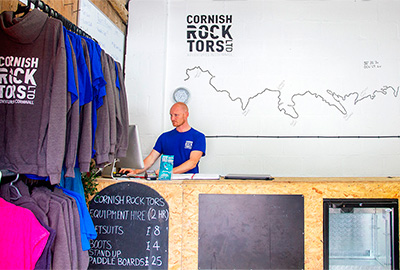
Our booking office – with no heating or air conditioning!
Our Online Presence
When we redesigned and re-launched our website a few years ago, our web developer Ian moved our website hosting to a company whose servers are powered by renewable energy. We hadn’t really considered it before, but it turns out that the internet has a massive carbon footprint (approximately 3.7 of global emissions, so if it were a country the global IT sector would be the third most polluting after China and the U.S.A.). All of the information on the internet is stored on servers (like hard drives) that have to be powered and also kept cool, so every time you do a search or access a website, your device is asking a server to send it the information that it has stored on it, and that has a carbon footprint. Because our website’s servers are powered by renewable energy there are no associated CO2 emissions (and if the phone/tablet/computer you’re looking at our site on is powered or charged by renewable energy then even better!). We also use G-mail, and have a presence on Facebook and Instagram – Google, Facebook and Instagram are also hosted and run using renewable energy. So is the booking engine that we use, Eola. Therefore our online presence is carbon neutral.
Banking
For a business of our size, all of the efforts above would be worth nothing if we banked with an institution that invests in fossil fuels – and most do, but not ours. Cornish Rock Tors has banked with the Co-operative Bank since day one, over sixteen years ago. The Co-operative Bank is a “beyond carbon-neutral” business (and has been since 2007), they support international efforts to tackle climate change, actively support organisations whose activities promote a healthy environment, and do not provide banking services to customers that conflict with those commitments. It turns out that where you put your money (banks, pension funds, etc) can have more impact than most other climate actions, and it’s pretty easy to make that impact positive.
Reducing Our Carbon Footprint
Having assessed and measured our carbon footprint (albeit, a little roughly), the first order of business is for us to look at ways in which we can reduce it, because creating less carbon dioxide going forwards is far better than carrying on as normal and offsetting. Our carbon footprint across Scopes 1 and 2 are really quite small, and we are a service/experience business (not making and selling physical products), so the place that we will have to look for future savings will be our supply chain.
How We Offset Our Carbon Footprint
We calculated our total 2021 carbon footprint across scopes 1&2 to be 1.85 tonnes of CO2e.
We chose to offset that carbon footprint for 2021 with Climate Care, a well established carbon offset provider (Co-Op, Bulb, Aviva and Microsoft all use them) and certified B Corporation who develop and invest in carbon reduction projects around the world.
How We Went Beyond To Be A Regenerative Business In 2021
The ocean is incredibly important to us here at Cornish Rock Tors. No prizes for guessing that. We’d have loved to have offset our residual carbon emissions with an organization or project working in the emerging blue carbon sector, protecting, restoring and enhancing the ocean and coastal habitats that can sequester and lock away carbon (see below). This is such a new field compared to renewable energy or tree planting though, and it’s so hard to measure and quantify in the ocean, however, that we couldn’t find a reliable way to offset our carbon in a certified scheme. So, we decided to invest the same amount as our certified carbon offset in a blue carbon project, making Cornish Rock Tors beyond carbon neutral and a climate positive, regenerative business. We chose to donate to The Ocean Conservation Trust, a Plymouth-based global Ocean conservation charity whose work focuses on pro-Ocean behaviour and habitat restoration, in particular protecting and regenerating the fragile blue carbon habitats of sea grass meadows.
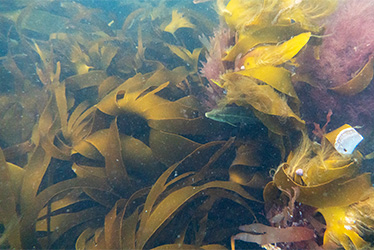
Blue carbon habitat
What Is Blue Carbon?
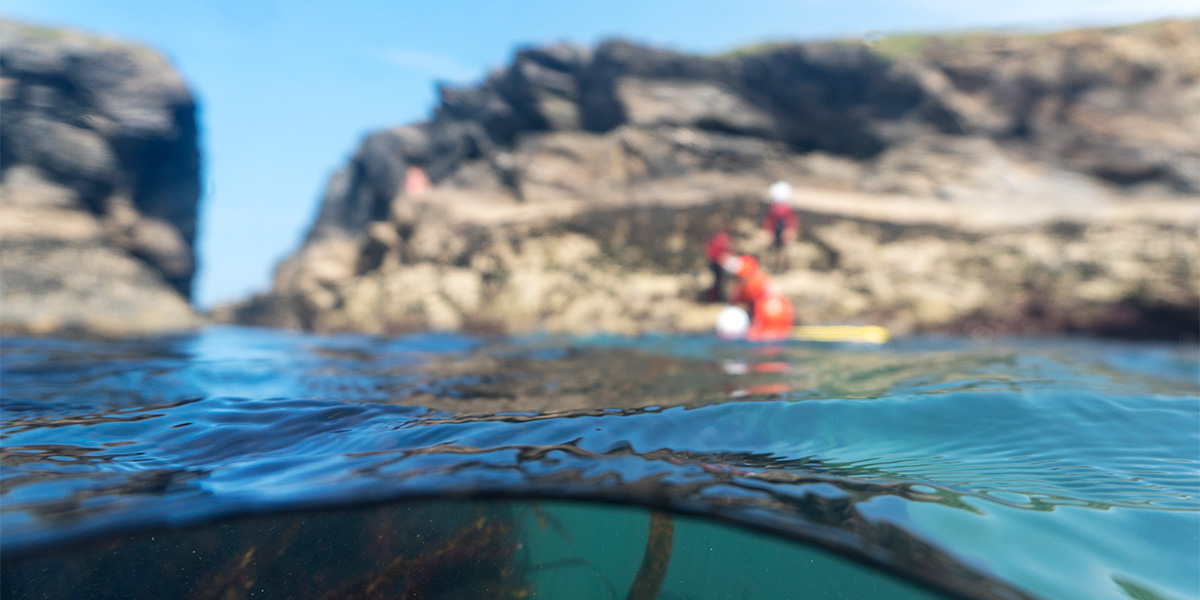
Blue carbon is the name for the carbon that is captured and locked away in marine and coastal ecosystems – primarily in coastal soils and sediments, and algal forests (seaweeds, in particular kelp). Coastal ecosystems such as salt marshes, coastal wetlands, mangrove forests and seagrass meadows are particularly important; even though coastal environments account for only 2% of total ocean area, 50% of the carbon stored in sediments in the ocean is in coastal areas. Mangrove forests can sequester carbon at a rate 2-4 higher than the same unit area of mature tropical forest, whilst seagrass meadows are up to 45 times more effective than the most pristine Amazonian rainforest in their ability to absorb excess CO2 from the atmosphere. These coastal habitats are and will become increasingly important in mitigating the impacts of the climate crisis, providing a buffer zone for coastal communities during storms, regulating water quality, and providing habitats for food production and food security.
Blue carbon is an emerging field of research, in particular around the potential of kelps to rapidly sequester carbon and then transfer it to the deep ocean where it will be stored (kelp grows around 30x faster than terrestrial plants, and giant kelp can grow up to 45 meters in height from the sea bed), but its potential is enormous. We’re excited to follow the research and hope to see blue carbon grow in importance, so that these crucial and fragile habitats can be protected, and developed further.
Our aim is to repeat this process next year, increasing the accuracy of our measurement and also taking every opportunity to reduce the carbon footprint of our business. This year’s efforts are not perfect, but it is a start and that is what is important.