- News
- |
Cornish Rock Tors Carbon Neutral and Ocean Positive in 2022
This time last year, for the first time, we measured and offset Cornish Rock Tors’ carbon footprint for the previous season (2021). It wasn’t a one off action, because the climate and ecological crisis isn’t getting any better, and we’ve just done the same again for our 2022 season – measuring and offsetting our carbon footprint and then making an equivalent donation to a marine environment charity working to restore blue carbon habitats, making Cornish Rock Tors a regenerative business.
“As a business working in and connecting people to the beauty of the natural world we believe that it’s our duty to protect it, and to take steps to restore it.”
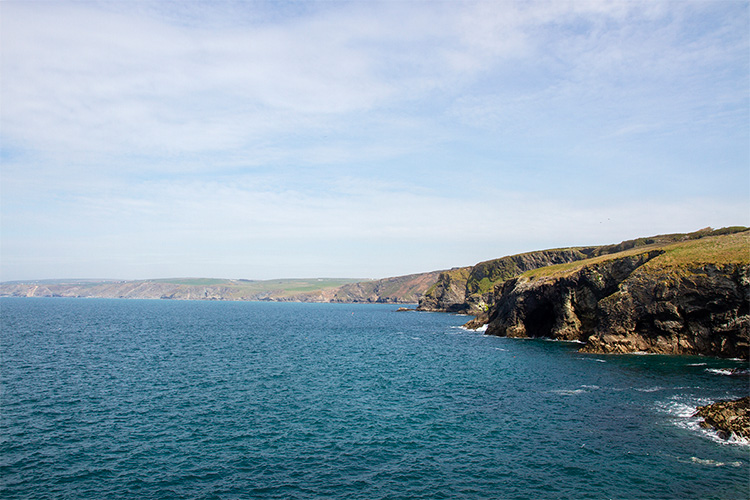
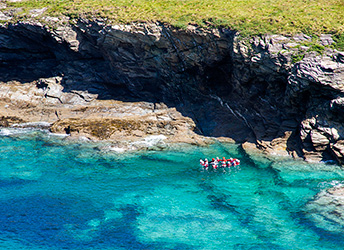
The Cornish coast north of Port Gaverne, where we run our activities and trips.
What is a Regenerative Business?
A business is deemed to have gone beyond simply being carbon neutral and become ‘regenerative’ if, in the simplest terms, the planet and natural world would be worse off if that business were to cease operating. For us, that means measuring our carbon footprint and after offsetting it, then going beyond that and contributing to a charity that actively restores the marine environment and its carbon-sequestering potential. If we ceased trading there wouldn’t be a carbon footprint that would need to be offset, but importantly there wouldn’t be an environmental gain from our contribution to support marine environment charities.
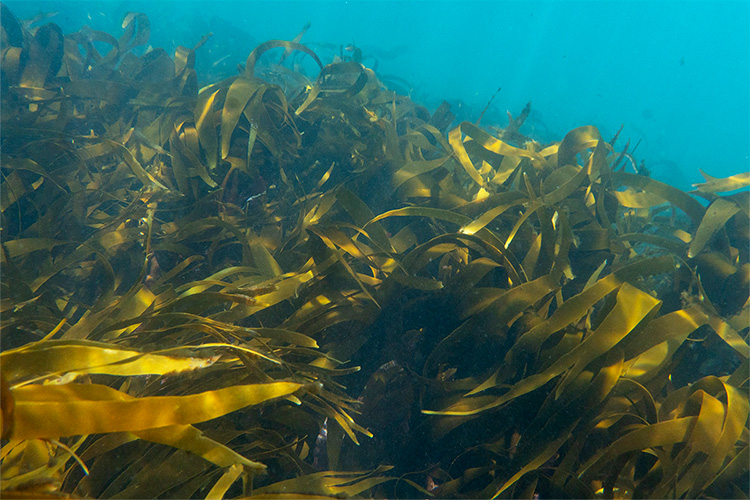
Kelp
Our 2022 Carbon Footprint & Figures
Last year we detailed what we measured and why (read it here). For our 2022 season, the figures are very similar, so we’re going to present them in a shorter list. We are again addressing our Scope 1&2 emissions (travel/fuel consumption and energy consumption in the form of electricity, respectively) and several of our Scope 3 (supply chain) responsibilities. Neutralising Scope 1&2 footprints makes a business carbon neutral; accounting for Scope 3 completely using certified schemes and reducing emissions in line with science-based targets and the Paris Agreement would make a business Net Zero.
Travel and Fuel Consumption
Like last year, we over-estimated the use of the company vehicle travelling the ten mile return trip between Ben’s home and Port Gaverne to daily (even though we’re only open Easter through October)to allow for and absorb longer journeys such as trips to our target sports range at Polzeath: 10 miles x 365 days in a Toyota Hilux = 1.6 tonnes of CO2e.
Last year our support and safety boat was used less (several swim supports, no safety incidents and no photo shoots) and used no more than 45 litres of unleaded fuel. The tonnes of CO2e from emissions per liter of unleaded fuel is 0.0239 (2.4kg), so we calculate the boat to contribute 108kg, or 0.108 tons, towards the business’ carbon footprint.
Energy – supplied through our landlord The National Trust, which we understand to be on a renewable electricity tariff with Good Energy, receiving power from the Delabole wind farm. As such our electricity has no carbon footprint.
Online Properties – Our website is hosted on servers powered by renewable energy. The same is true for our booking engine (Eola). We use Google Workspace (Google’s servers are run on renewables and as a business they are currently calculating and offsetting their carbon footprint since inception) and our social media activity has no footprint because Meta also power their servers using renewable energy. Carbon footprint = 0
Finances – What you do with your money and how those institutions invest has a huge climate impact. We have always banked with The Co-operative Bank who are a “beyond carbon-neutral” business (and has been since 2007). They support international efforts to tackle climate change, actively support organisations whose activities promote a healthy environment, and do not provide banking services to customers that conflict with those commitments. Carbon footprint = 0
Cornish Rock Tors’ 2022 Carbon Footprint = 1.708 tonnes
Offset using a certified scheme with Climate Impact Partners
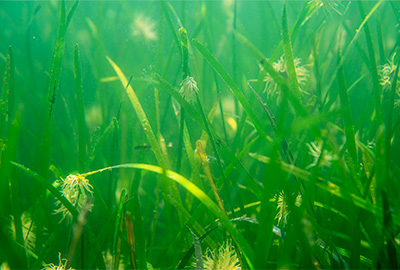
Snakelocks anemones growing on leaves in a seagrass meadow, Helford River Estuary, Cornwall.
Supporting Seagrass
The ocean is a precious environment to all living creatures, not just us here at Cornish Rock Tors. More than 50 percent of the oxygen we breathe comes from the ocean, and it has enormous potential to help reduce and mitigates the effects of the climate crisis. Because Blue Carbon is still an emerging science and focus of study, it is not yet possible to offset carbon emissions with blue carbon schemes. In our efforts to put back more than we take, so to speak, as well as our certified offset we are again donating to the Ocean Conservation Trust for the amazing work they are doing protecting and regenerating seagrass habitats here in the UK. Ocean-based climate action has the potential to close the ‘emissions gap’ by up to 21%.
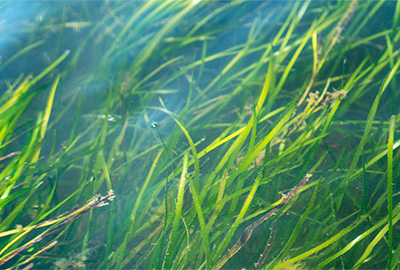
Seagrass at low tide.
Seagrass can absorb carbon up to 35x faster then the Amazon Rainforest, drawing it deep into the seabed where it is stored for millions of years. Despite covering only 0.2% of the seabed worldwide, seagrass meadows are estimated to store 10% of the carbon in the ocean
Seagrass meadows are incredibly fragile, threatened, and valuable habitats, found on the coasts of every continent with the exception of Antarctica. They stabilise the seabed, provide a buffer zone between the ocean the shore reducing erosion and the severity of coastal flooding, and are an important habitat.
The Ocean Conservation Trust’s Blue Meadows project aims to protect, restore and eventually regenerate seagrass meadows at scale around the Southwest coastline of the British Isles.
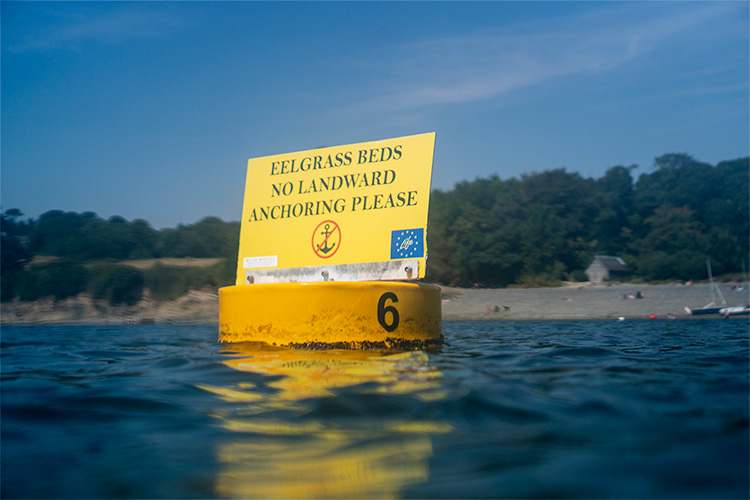
No mooring buoy marking the edge of a seagrass meadow on the Helford estuary, Cornwall