Fact File: Grey Seal (Halichoerus grypus)
The coast of Cornwall is an incredibly rich marine ecosystem and habitat, and one of the species that calls it home is the endangered grey seal.
Grey seals are unique to the North Atlantic, and around 38% of the entire world’s population live around the coast of the British Isles. To provide some context, in the UK there are more red squirrels than there are grey seals. If you’re visiting Cornwall however, you have a fairly good chance of spotting a grey seal, as they frequently “haul out” onto the shore at favoured sites to rest, digest and pup.
Along the stretch of wild and untouched coastline where we run our activities we are lucky enough to occasionally spot grey seals, particularly during our sea kayaking trips that cover greater distances along the coast. Seals are highly mobile and cover huge distances in search of food, and in their first year pups travel extensively, mapping the coast with their incredible “inbuilt GPS”.
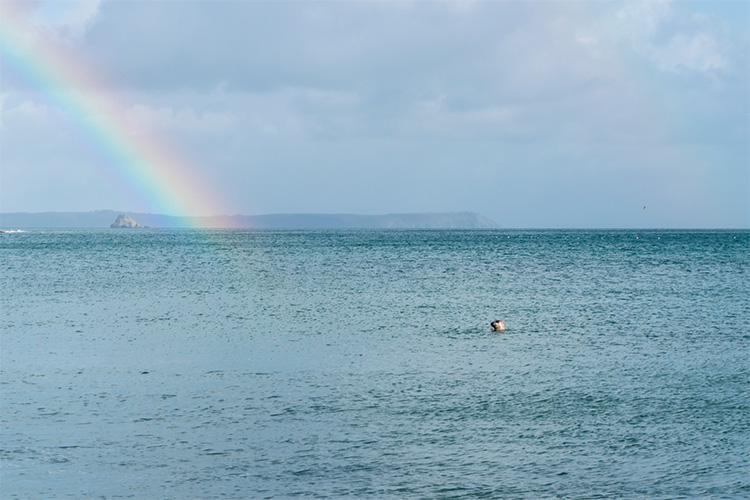
A grey seal at the end of a rainbow, off the coast of Cornwall
Grey Seals
Grey seals are marine mammals that are incredibly well adapted to a life in the wild North Atlantic. They dive to depths of up to 120 meters in search of food, often spending around ten minutes underwater. They can spend up to half an hour underwater however, storing oxygen in their blood and muscles as holding it in their lungs would make them too buoyant (and at risk of getting “the bends”). They have a large volume of blood to carry more oxygen, and when diving in cold water their heart rate slows by about a third and the blood vessels in their extremities constrict so that blood pools in their core and all non-essential processes are slowed or stopped, allowing them to use less oxygen and spend more time underwater. This is known as the mammalian diving reflex, and is something that humans still exhibit however nowhere near as strongly or successfully! They forage for food on the seabed, mainly eating sand eels and dragonets, but also feeding on larger fish, crab and even squid. They use sight, sound and the sense of vibrations through their sensitive whiskers to locate prey, then using a short burst of incredible speed to capture their food in their strong jaws. Seals have large eyes that can focus underwater thanks to near-spherical lenses, but they can see almost as well above water as well. The surface of their eyes (the cornea) is very strong, similar to us wearing a pair of goggles and being able to see above and below the surface!
Seals spend a great deal of time at sea, hauling out onto land at certain times of year to give birth and suckle their pups (through the autumn in the eastern Atlantic), moult (spring) and to rest after periods of diving and feeding. There are several haul out “hot spots” around the Cornish coast, but you could spot seals hauled out on remote or inaccessible beaches, tiny coves, sea caves or offshore rocks anywhere around the Celtic Sea, as well as offshore.
“As a top marine predator, the health of grey seals is representative of the wider marine ecosystem that they exist in. If our marine environment is healthy and thriving then seals will too. Being a top marine predator they also represent the health of our marine environment as their range and diet overlap with our own – if they are doing well, then so can we.”
Abby Crosby, Marine Conservation Officer, Cornwall Wildlife Trust
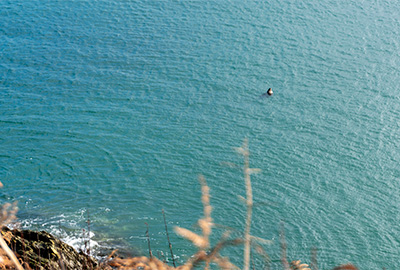
Seal spotting from the cliff tops
What To Do If You See A Seal
As an endangered species, it is enormously important that we protect and look after our seal population, and learn how to make human interactions with them positive. It is common for people to get too close to seals, out of curiosity or to try to take photos, but this can be incredibly harmful to seals. Disturbance stresses them, interrupts their rest and wastes energy, and can result in injury or death in particular if they are scared into the sea off rocks. During the autumn months, disturbance can lead to pups being abandoned (which will lead to almost certain death unless rescued and rehabilitated at Cornwall’s Seal Sanctuary), or to death through exhaustion of mothers who lose a quarter of their body weight whilst weaning pups anyway as they feed their pups rather than themselves over a period of 3-4 weeks. In their first few months pups have just enough energy to teach themselves to forage and feed, so rest is vital and disturbing them wastes this precious energy.
If you see a seal you should never seek out an interaction with them and always:
- Keep at least 100 metres away from the seal or any known seal haul outs
- Try to stay out of sight
- Be quiet
- Position yourself downwind so that they can’t smell you
If a seal looks at your directly, then you have disturbed it, and should back away carefully so that it isn’t forced to move itself. If they make a big splash (a “crash dive”) in the water, or hurriedly enter the sea off rocks or the beach, then it means that they are definitely distressed.
“We have a duty of care towards these incredible creatures, and we must all consider our actions and the implications they have on this vulnerable species. We must improve the way we co-exist, and consider how minor changes to our behaviour can have major positive consequences to animals such as Atlantic grey seals; from what fish we eat and what we flush down our toilet, to what coastal development we support and backing campaigns for appropriate marine protected areas.”
Abby Crosby, Marine Conservation Officer, Cornwall Wildlife Trust
For more information and guidance on marine wildlife interactions, please take a look at the Cornwall Marine and Coastal Code.
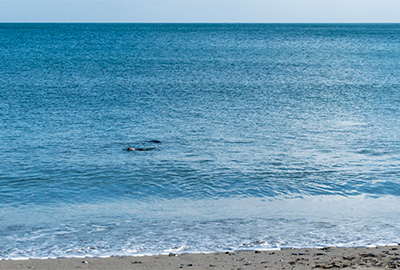
Young seals playing near a beach in Cornwall
Cornwall Seal Group Research Trust
We are lucky, and Cornwall’s grey seals are lucky, to have the Cornwall Seal Group Research Trust. Founded in 2000 by Sue Sayer, over the last twenty years CSRGT has built up a network of volunteers who spot, identify, and track seals using their unique fur patterns (which act like a fingerprint). They’ve successfully identified and data-based 72,000 seals through regular surveys and by analysing photos, building up individual seal histories through repeat sightings and amassing a huge body of data about grey seals. Sue can recognise many of Cornwall’s resident seals on sight, which is absolutely incredible. Through their network of volunteer hubs and other seal research groups sharing their knowledge and information, they discovered that grey seals from the southwest have travelled as far as France, Belgium and Holland on the coast of mainland Europe, and Ireland, Wales and the Isle of Man around the British Isles. The Cornwall Seal Research Group’s findings feed in to international networks to help inform coastal and marine environmental policy and planning.
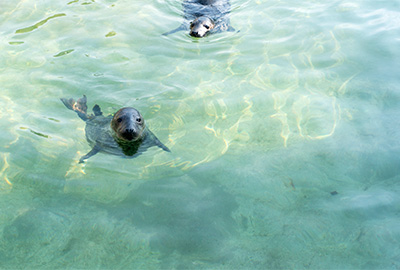
Young seals in the rehabilitation pool at Cornwall Seal Sanctuary
The Cornish Seal Sanctuary
Sick and injured seals and abandoned seal pups that are rescued around the coast of Cornwall by the Marine Strandings Network are usually taken to the Cornish Seal Sanctuary for treatment and rehabilitation. Founded by Ken Jones in 1958, the sanctuary has grown from a rescue centre with just a single pool in St Agnes on Cornwall’s north coast to become the largest seal sanctuary in the country located at Gweek on the Helford River, on Cornwall’s south coast. Every season they rescue around 60 pups, rehabilitating and releasing all but the most critical of cases (who become permanent residents). It costs around £2000 to rehabilitate an average seal pup. The Seal Sanctuary is open to the public, so once it is safe to reopen we would encourage you to pay enjoy a day out there when you visit Cornwall in 2021.
Download free kids activity sheets from Cornwall Seal Research Group Trust here!
Click here to donate to support the Cornwall Seal Research Group Trust