Fact File: Guillemots (Uria aalge)
Peak seabird season around Port Gaverne is between March and the end of July, as birds that usually spend their lives at sea build a nest on the steep cliffs for the few months of breeding season. One of the species that nests in tightly packed colonies on the cliffs north of us here are the elegant guillemots.
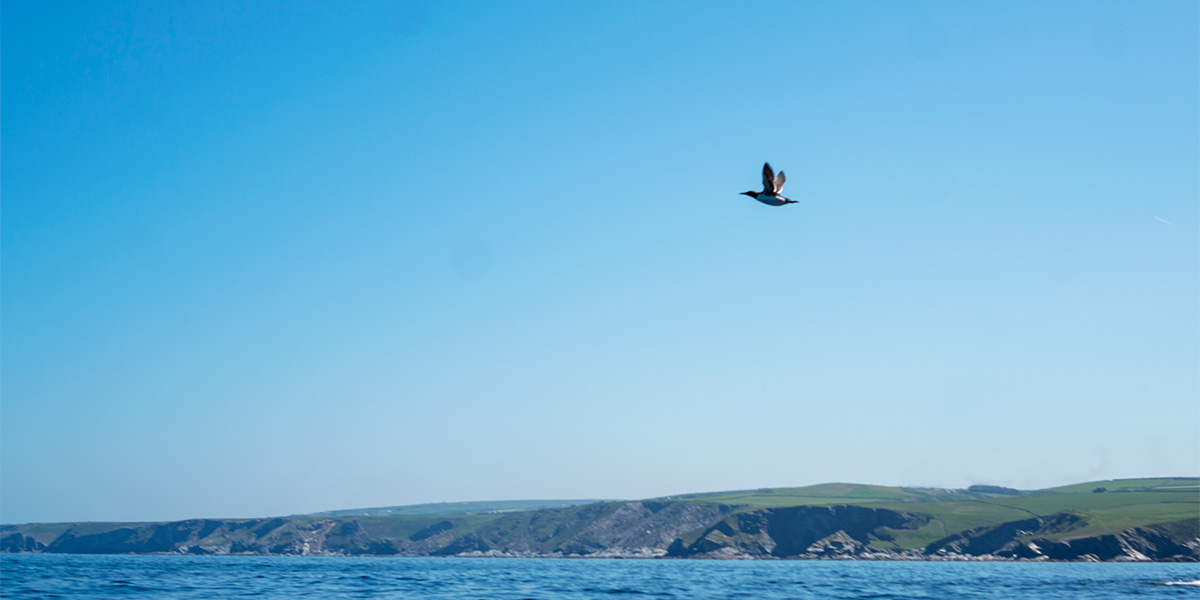
Guillemots are the most common members of the auk family found around the UK, with an estimated population of 950,000 pairs. They are however classified here as amber under the Birds of Conservation Concern 5: the Red List for Birds (2021). From a distance guillemots can look quite similar to their cousins the razorbills; they are dark chocolate-brown with a white tummy/underside, and a relatively thin “classic” beak (the razorbill is almost black and has a shorter, stubbier beak). In summer, some have a white ring around their eyes that then extends down their neck, rather like a bridle, but this is more common further north in lower latitudes. They are a little larger and heavier than the razorbill, around 40 cm long/tall and weighing around a kilo, but they appear more slender.
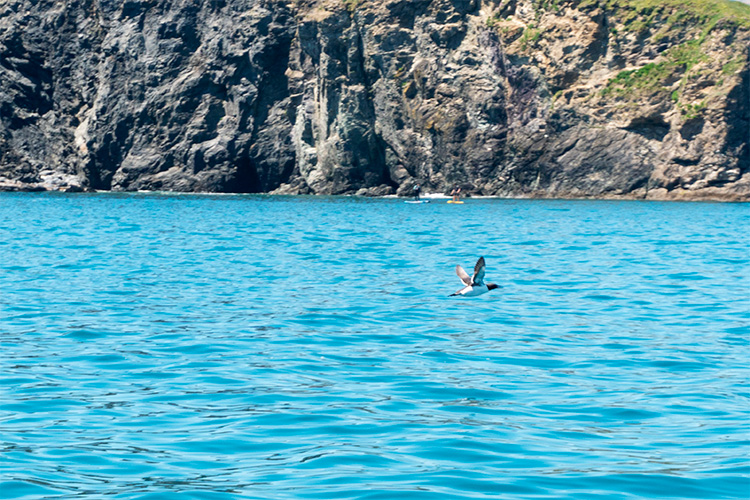
Fast & Low! Guillemots fly at up to 50mph
When they come ashore to breed and nest, guillemots go for safety in numbers and pack shoulder to shoulder along narrow ledges. Often, each nesting pair’s territory extends only about a beak’s length outside of the nest! Females lay a single egg each year between May and July, and their eggs have evolved to be pear-shaped – one popular theory being that this shapes means that if an egg rolls out of the nest it will roll in a circle and reduce the risk of it falling off the edge. Guillemot chicks are amongst the earliest seabirds to fledge their nest, taking a leap of faith from the nest off the edge of the cliff into the sea with their father when they are about three weeks old. The father bird will then look after the chick at sea until it is old enough to fend for itself, whilst the mother often remains on the nest to defend it from competitors.
Guillemots eat a diet of fish, crustaceans, marine worms and even squid, diving down from the surface of the sea (rather than diving into it) fishing and foraging underwater for up to two minutes. Because for most of the year they live at sea, they’re very vulnerable to become tangled in fishing nets (a 2020 study of the UK registered fishing fleet by the Scottish Ocean Institute at the University of St Andrews estimated that each year between 1,800 and 3,300 guillemots are caught by static net fisheries) or fouled and killed by oil spills, as well as being threatened by the impacts of climate change and over-fishing on its food sources.
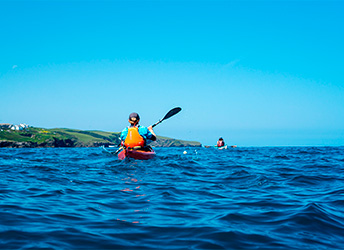
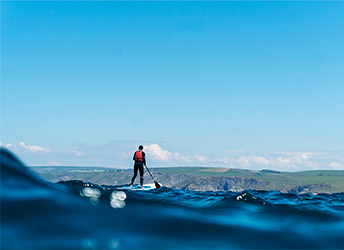
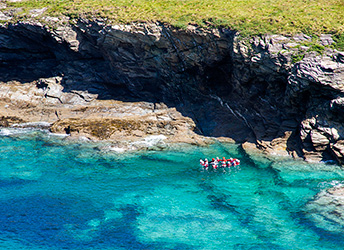
We’re very fortunate to see guillemots frequently at this time of year on our sea kayaking and stand-up paddleboarding sessions that head north up the coast of Port Isaac Bay. They choose their nesting sites wisely, to be safe from predators, but paddling silently beneath the cliffs we are able to see them without disturbing them. We find that the guillemots tend to be a bit more cautious than the razorbills and keep their distance a bit more, but we still get great views of the parents leaving the nests, dropping down and flying low out to sea to search for fish and food.
Join us on a sea kayaking or paddleboarding session soon for a chance to spot guillemots and more, and please stand up for seabirds and the protection and restoration of the marine environment whenever possible.