Sea Caves in North Cornwall
The coast of North Cornwall is known for its cliffs and beaches, and along those cliffs are countless sea caves.
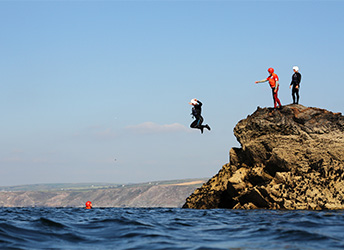
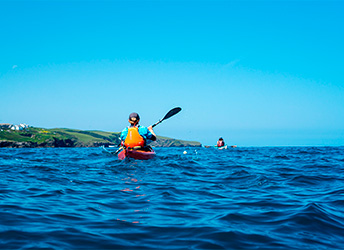
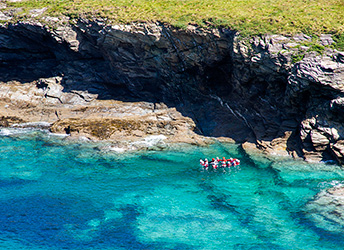
Some of those caves are at the backs of beaches so are easily accessible on foot, but many of them can only be accessed from the water, and as a result few people have visited them. There are some incredible sea caves here in Port Isaac Bay, and we often visit them as part of our coasteering sessions or, if the conditions are right, an entire sea kayaking group can paddle into some of them.
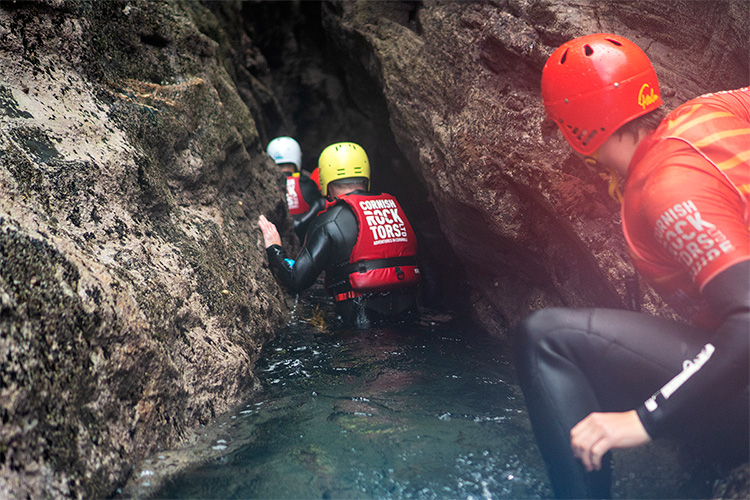
The cave at the back of Shrimp’s Zawn
How Sea Caves Form
Most sea caves are formed through erosion as opposed to the process of dissolution, which is how most terrestrial caves form (when rainwater becomes slightly acidic and dissolves limestone). The proper name for sea caves are littoral caves because they occur at the junction of land and sea, and are formed where natural weaknesses in the rock such as faults, fractures and intrusions are exploited and expanded by the repeated action of the waves. The compressive force of waves and the hydraulic forces that occur where a volume of water and air is forced into a narrowing crack erode the rock of the cliff. As that eroded area expands and deepens it becomes the focus of more wave energy and the formation of the cave accelerates as waves rebound within the growing crack or focus into narrowing fissures. Over time a sea cave is formed until it reaches it maximum potential size.

Huge sea cave on the coast of North Cornwall
When Sea Caves Stop Growing
The size that a sea cave can reach depends on many factors, but usually either happens when the cave becomes so large and wide that the roof collapses and it ceases to be a cave any longer, creating a narrow gulley (known in Cornwall as a “zawn”) or a collapsed cave if the internal ceiling collapses but not at the entrance (leaving a cave mouth with a large skylight inside, as at Lundy Bay). Alternatively, if the roof begins to collapse but doesn’t fall completely and simply deposits boulders inside the cave, they can stop or disperse the energy of waves rolling into the cave and therefore limit any further erosion.
The Geology of Port Isaac Bay
The entire county of Cornwall has fascinating geology, with the coastline of Port Isaac Bay between Pentire Head and Tintagel Head that was formed during the Devonian and Carboniferous periods being particularly interesting for geologists.
Pentire Head to the West features extremely complex rock structures, formed originally as layers of sediment on the seabed deposited around 400 million years ago that were then squeezed and raised around 300 million years ago in a phase of mountain building.
Between Port Isaac and Tintagel Head to the North East there is a sequence of Devonian slates and volcanics that have been folded three times. Further north of Tintagel that folding is particularly pronounced and visible, as the cliffs appear to have zig-zag stripes (chevron folding) in them. The thrust planes between the slate and the volcanic rocks offer weaker areas that wave action can erode to form caves. The best example of this is the famous Merlin’s Cave that extends through Tintagel Island from one side to the other.
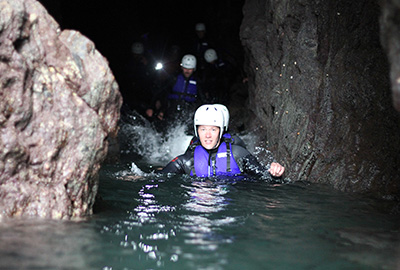
Exiting into the light!
What’s Special About The Sea Caves We Visit

Scarlet and Gold Cup Corals. Photo by Thomas Daguerre/Hydromotion Media

Paddling out of Cathedral Cave
Almost all of our coasteering sessions involve some sort of (optional) cave experience. All of our guides carry waterproof torches with them for the benefit of anybody who really wants to explore! Within these dark, cool places we often find some really interesting marine life sheltering, such as different star fish. Back in 2016 we guided a group of Cornwall Wildlife Trust’s marine staff and Shoresearch Cornwall volunteers into the cave at the back of Shrimp’s Zawn where we discovered scarlet and gold cup corals under the water. This was a really significant find as scarlet and gold cup corals are only found in a handful of locations in the UK and are restricted to the south and west coasts of Britain, Ireland and Wales.
This cave can, on a very low spring tide, link up with the cave in neighbouring Tridents Zawn, passing right through the small headland that separates them. We don’t take groups all the way through, but do take coasteering groups into the entrances on both sides. Passing right the way through is best left to well kitted up, experienced and prepared caving enthusiasts!
Cathedral Cave, just to the north of Tridents, is so called because inside the mouth of the cave it opens up into a large cavern. There is a coasteering jump in the mouth of the cave itself, and if there is not too much swell then we can paddle an entire sea kayaking group inside this cave.
There are other sea caves that we can explore, and some blow holes too, but you’ll have to come coasteering or sea kayaking with us to find out all about them! Going into a sea cave is completely optional on our sessions – we understand that not everybody enjoys caves and some people really don’t like them and would rather stay outside in the open air, so you won’t miss any other part of a session by skipping a cave.
Our activity sessions are all about interacting with and enjoying the amazing natural world that we have here on the coast of Cornwall, and that extends beyond the wildlife and being out in the elements to the rocks and features themselves that we use to enjoy the coast here.
Come out on the water with us, and see it all for yourself.