Seaweeds of Cornwall
We often say during the briefing at the start of a coasteering session “if it looks green and slippery, red and slippery, or brown and slippery, then it’s probably slippery – so don’t step on it!”
The rocky coast around Port Gaverne where we run our activity sessions is a prime habitat for seaweeds. Cornwall’s coast is home to over 500 species of seaweed, groups of marine flora (all algae though, rather than what we’d know as plants) that are so varied that they are most easily classified by their colour than their botanical classifications.
“No gardener can match the perfection of beauty found in a rock pool. The many browns, greens and reds of the seaweeds are naturally arranged for greatest artistic effect and currents and small waves dramatically change the view every few seconds as the fronds slip over one another and the light changes.”
About Seaweeds
Algae was present on this planet well before the dinosaurs – fossils have been found dating back 1.6 billion years, whereas dinosaurs only showed up 230 million years ago – and they’re still with us today. They range in size from the microscopic phytoplankton that float in the sea and which forms the base of the entire marine food chain, through to the giant kelp that can grow up to 45 meters long (some at a rate of 60cm per day!) and form incredible underwater forests. Whether a forest of giant kelp or a collection of seaweeds in an intertidal rockpool, seaweeds form an important habitat providing shelter and a food source for a huge range of marine life. They’re also an important carbon sink; seaweeds use the energy of the sun to turn carbon dioxide into energy, biomass and oxygen (photosynthesis, just like plants and trees on land do), which is why every other breath that we take comes from the ocean.
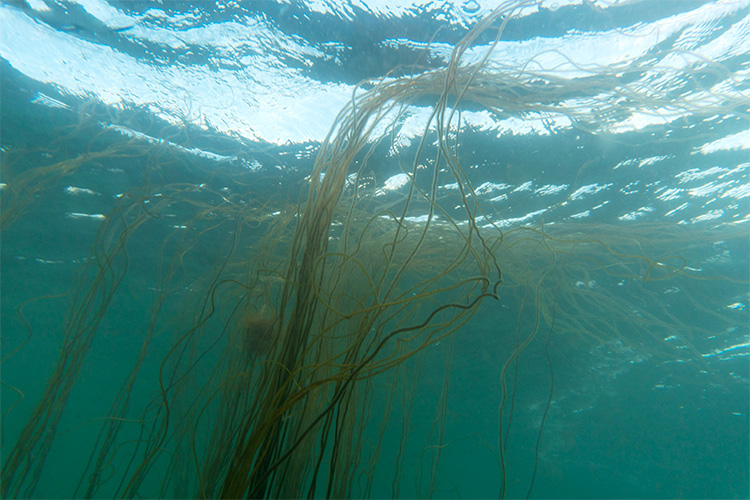
sea spaghetti
How Humans Use Seaweed
Humans have been collecting, harvesting and using seaweeds for thousands of years, for medicine, skincare or in cosmetics, as a fertilizer on fields, and eating it as food. There’s not a huge history of the English eating it, but there is around “the Celtic fringes” – Scotland, Ireland, Wales and here in Cornwall, as well as Brittany on the north coast of France. It’s also a common part of the diet in many areas around the world, particularly the Far East. As a food, seaweed is actually classed as a “superfood” because it is so nutritious. It is packed with more vitamins and minerals than any other food group, including iron, magnesium, zinc and the 56 trace elements that our bodies need for successful physiological function. If you don’t think that you’ve ever eaten seaweed, then just stop for a second and consider if you’ve ever eaten sushi – nori, the dark sheets used to wrap rice is made from seaweed. Amazingly, seaweed makes up 10% of the diet in Japan! And if you look on the ingredients list of a carton of nut milk, or yoghurts, you might see carrageenan listed – this is a type of edible red seaweed (also known as Irish Moss) that is commonly used to thicken, emulsify and preserve foods and drinks.

Gutweed and Dulce Exposed At Lowtide
Common Seaweeds Around Cornwall

Oarweed
Oarweed (Laminaria digitata)
Oarweed is a very common kelp found around our coasts. Large, thick and leathery dark browny-green fronds divided up into ribbons are attached to the seafloor or rocks by a root-like foot, or holdfast. Oarweed forms dense forests at high tide, and as the tide drops out and the water gets shallower they bend over to remain underwater. Kelp (also known as kombu) is used as a flavour enhancer to add umami (“savouriness”) to a dish, but is usually removed before serving. Sometimes oarweed (like all seaweeds) can be torn up and washed ashore during storms – if you find some on the beach then you will probably be able to spot some of the small species who call this kelp their home, from blue rayed limpets and brittle stars, to sea lice that live inside the holdfast.
Sugar Kelp (Saccharina latissima)
Single large brown fronds with distinctive wavy edges that attaches to the rocks or seafloor by a single foot or holdfast. Sugar kelp is found in sheltered spots or in large rockpools, and its short stipe (stem) is very flexible so that as the tide drops out and the water gets shallow it can bend over to keep itslf submerged.
Sea Spaghetti (Himanthalia elongate)
An edible seaweed that looks like long browny strands of thick spaghetti – or hair! Sea spaghetti grows up to around six foot in length, and can sometimes form in mats on the surface when torn from the rocks in storms.

Rainbow Wrack
Rainbow Wrack (Cystoseira tamariscifolia)
A small, spikey looking seaweed that grows in shallow water (particularly rockpools), with a beautiful and vivid blue, purple and green colouration. The colours are brightest in the spring, but as the rainbow wrack is exposed to more sunlight at each lowtide as the seasons progress, the colours fade over time.
Bladder Wrack (Fucus vesiculosus)
Nature’s bubble-wrap! Bladder wrack is one of the most common and easily recognized seaweeds on our shores. Olive brown in colour, it has branching fronds with air bubbles (bladders) along the fronds that make the fronds float and stands the seaweed up in the water when submerged.
Sea Lettuce (Ulva lactuca)
Another common and distinctive seaweed that can be found floating in rockpools or on the surface alone or in large mats if detached, or attached to rocks by a small holdfast. Sea lettuce looks like a lettuce leaf, or a sheet of thin translucent green plastic or polythene. It’s only two cells thick (hence it being translucent) but is remarkably tough. Not only does sea lettuce look like lettuce, but it is also edible and being a green seaweed, doesn’t require cooking or much processing.
Gutweed (Ulva intestinalis)
Also known as grass kelp, gutweed grows in the upper intertidal zone, in shallow water and in rockpools (sometimes on shells or on other larger seaweeds!), forming a bright green (sometimes bubbly) carpet when exposed at low tide. The fronds are unbranched and are actually thin tubes that trap air to help it float when submerged. Another edible seaweed, this is often deep fried and served as green crispy seaweed.
Dulse (Palmaria palmate)
Dulse is the best known of the UK’s edible seaweeds (after the Welsh specialty, laverbread), for the simple fact that once rinsed it can be treated a bit like cabbage and cooked as a side or added to mashed potato. It has a savoury, salty, slightly smokey flavour and is sometimes said to taste like bacon! Dulse is characterised by flat red fronds that float when submerged and which can grow up to 50cm long.
Foraging Seaweed
We’ve mentioned several times above that many seaweeds that you’ll find on the coast of Cornwall are edible. You can purchase seaweed ready to eat from some supermarkets, from the likes of the Cornish Seaweed Company, but obviously you could also collect it from the seashore. This presents a bit of a grey zone – there is no common law right to pick seaweed.
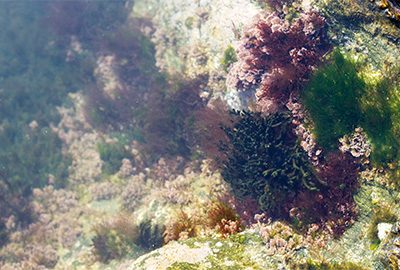
Seaweeds In A Rockpool
According to the Cornwall Good Seafood Guide, “under the public right to fish in tidal waters, floating seaweed can be collected at high water. However, when the tide is out, this right does not extend to collection of seaweed from the shore. In order to collect seaweed from the shore, the landowner’s permission is always required, this includes the collection of drift seaweed as well as attached seaweed.” Much of the area below mean low water is the property of the Crown Estate, with the land above the mean low water mark being owned by the Duchy of Cornwall here in Cornwall, or the National Trust, or perhaps owned or leased to private land owners.
If you can get permission, then taking a small amount shouldn’t be a problem – use scissors to remove part of each specimen (don’t tear up the whole thing) so that you’re leaving plenty behind to regrow and replenish. Wash it thoroughly in several changes of water before using or drying to grind up and use later.
Learn More About Seaweeds
The fifth lesson in The 2 Minute Foundation’s online beach school series is all about seaweeds and sustainability, looking at what seaweeds are and identifying some. There are also some great seaweed-based activities that you can download from their website.