- News
- |
Making Cornish Rock Tors’ 2023 Carbon Neutral & Ocean Positive
For the third year running we have just measured and more than offset the carbon footprint of Cornish Rock Tors’ operations last year.
That means that not only have we negated the carbon emissions that we were responsible for in 2023, but that we’ve gone beyond to make sure that us being in business last year actually had a positive impact on our planet.
2023 saw some scary records being broken, with marine heat waves (the equivalent of “a wildfire in the sea”, record sea surface temperatures and sea level rise, and record low Antarctic sea ice to name but a few. This is more than enough reason to do whatever we can to not only reduce our impact on the environment that we work in and rely upon, but to encourage others to do the same by fostering appreciation and respect for the ocean.
Save Our Seas
Cornish Rock Tors’ 2023 Carbon Footprint & Figures
In previous years we have detailed exactly what we measured and why – our Scope 1 and 2 emissions, and several of our Scope 3 responsibilities.
Scope 1 and 2 emissions are those that a business is directly responsible for (travel/fuel consumption and energy consumption in the form of electricity, respectively). Scope 3 emissions are those generated in our supply chain. Negating Scope 1&2 emissions makes a business carbon neutral, whereas accounting for Scope 3 completely using certified schemes and reducing emissions in line with science-based targets and the Paris Agreement makes a business Net Zero.
As a small business we have focused on what we can easily reduce, measure and account for (Scope 1 & 2), minimised as many of our Scope 3 emissions as is possible and realistic, and then made sure that we have gone beyond in giving back to nature-based solutions so that by being in business the planet is actually better off.
Here’s how we did last year:
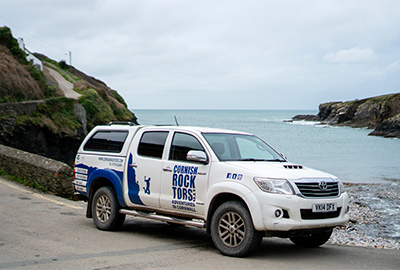
The only source of our Scope 1 carbon emissions in 2023
Travel and Fuel Consumption (Scope 1)
As with 2021 and 2022, this year we over-estimated the use of the company vehicle travelling the ten mile return trip between Ben’s home and Port Gaverne to daily. As it happened, Ben was very rarely at the beach or in the booking office in 2023 (he was recovering from brain surgery – more on that in our previous post) so the truck’s mileage will actually cover other team travel to and from work.
10 miles x 365 days in a 2014 Toyota Hilux = 1.68 tonnes of CO2e.
Last year our support and safety boat was not used at all (no safety incidents, it wasn’t used for any photo shoots and we used prone paddleboards for swim support).
Energy Consumption (Scope 2)
Energy – supplied through our landlord The National Trust, which we understand to be on a renewable electricity tariff with Good Energy, receiving power from the Delabole wind farm. As such our electricity has no carbon footprint.
The carbon footprint of powering our business = 0
Online Properties – Our website is hosted on servers powered by renewable energy. The same is true for our booking engine (Eola). We use Google Workspace (Google’s servers are run on renewables and as a business they are currently calculating and offsetting their carbon footprint since inception) and our social media activity has no footprint because Meta also power their servers using renewable energy.
Our online carbon footprint = 0
Finances – What you do with your money and how those institutions invest has a huge climate impact. We have always banked with The Co-operative Bank who are a “beyond carbon-neutral” business (and has been since 2007).
Carbon footprint of our banking = 0
Cornish Rock Tors’ 2023 Carbon Footprint = 1.68 tonnes
Offset using a certified scheme with Climate Impact Partners
Going Beyond Carbon Neutral
In the simplest terms, a business is ‘regenerative’ if the planet and natural world would be worse off if that business were to cease operating. So, once we have measured and offset our carbon footprint we make a donation twice the value of the cost of the offset to The Ocean Conservation Trust to support their work taking action to protect and restore nature for a thriving Ocean.
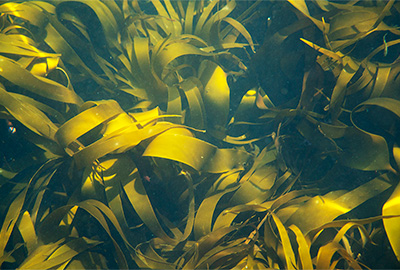
Sugar kelp underwater at Port Gaverne
The ocean is a precious environment to all living creatures. More than 50 percent of the oxygen we breathe comes from the ocean, and it has enormous potential to help reduce and mitigates the effects of the climate crisis. Blue Carbon is a developing area and there are very few certified opportunities to offset carbon emissions through ocean-based schemes around the UK. Therefore, we have opted to support The Ocean Conservation Trust’s work to protect vital ocean ecosystems, allowing them to regenerate with the aim of restoring them back to full health.
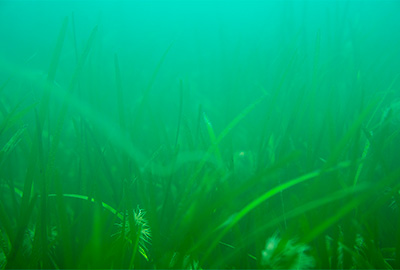
Seagrass in the Helford River, Cornwall
Over the past decade their focus has been on seagrasses, as they are one of the most valuable and biodiverse habitats on the planet. In the UK alone, we have lost nearly half of our seagrass beds since the 1930s, and whilst there are none near us on the coast of North Cornwall, there are valuable sea grass habitats off the south coast of Cornwall that need protecting and restoring.