Fact File: Northern Gannet (Morus bassanus)
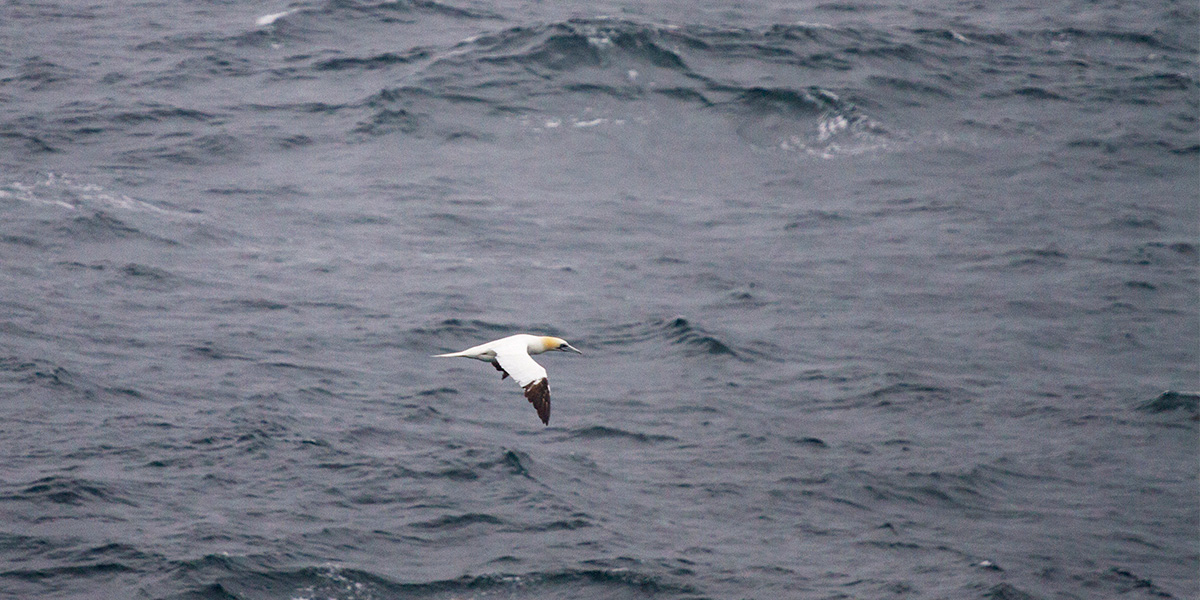
The northern gannet is the largest seabird in the North Atlantic, measuring up to a metre long and with a wingspan of between 165-185com (six feet!) and they’re shaped like a bright white missile. They are beautiful sea birds, white with a yellow head and black wing tips (although juveniles are brown and black), that are endemic to the North Atlantic and are found all around the coast of the UK between January and the end of August before migrating south to the west coast of Africa for Autumn and the start of winter.
Gannets are famous for diving from great heights, sometimes 20 – 30 metres in the air and hitting the water at up to 60mph with their wings folded back flat against their bodies. They have an extensive network of air-sacs between their muscles and skin to help cushion the impact from hitting the water at such high speeds. Their dives take them anywhere between 5 meters and 20 meters deep (female northern gannets are the ones that can dive the deepest), where they grab or even chase fish. The sight of a large group of gannets diving for fish out in the bay here is often a sign that dolphins are nearby, as the dolphins drive fish nearer to the surface where the gannets can pick them off.

Juvenile northern gannets on the wing.
295,000 pairs of gannets nest around the coast of the UK, accounting for approximately 55% of the world’s population. They tend to nest in large groups, often in enormous and correspondingly noisy and smelly colonies on offshore islands, particularly around Scotland, although there are several mainland cliff colonies. There are 21 of these colonies, some of which have been there for centuries, and this limited number of breeding locations means that they are classified in the UK as Amber under the Birds of Conservation Concern 4: the Red List for Birds (2021). Part of the reason for this is the devastating impact that contagious diseases such as H5N1 avian influenza can have on populations, as it can spread so quickly through the crowded colonies during nesting season.
We tend to see them offshore or passing through, but sadly through the end of last summer we did encounter dead gannets that had likely been the victims of the latest wave of bird flu washing up on our stretch of coast.
Gannets are also at risk from fishing, because they feed from the surface or on discarded by-catch from fishing boats, and can also get entangled in gill nets (a giant wall of netting suspended in the water between buoys). An estimated 400,000 seabirds a year drown globally as “by-catch” having become tangled in fishing nets, and around the UK northern gannets and guillemots are two of the species that are particularly at risk. Last winter an innovative “Looming Eye Buoy”, basically a scarecrow at sea, was trialed by Cornish fishing fleets having been developed by the RSPB in partnership with engineers from Fishtek Marine in an attempt to reduce the numbers of seabirds dying this way.
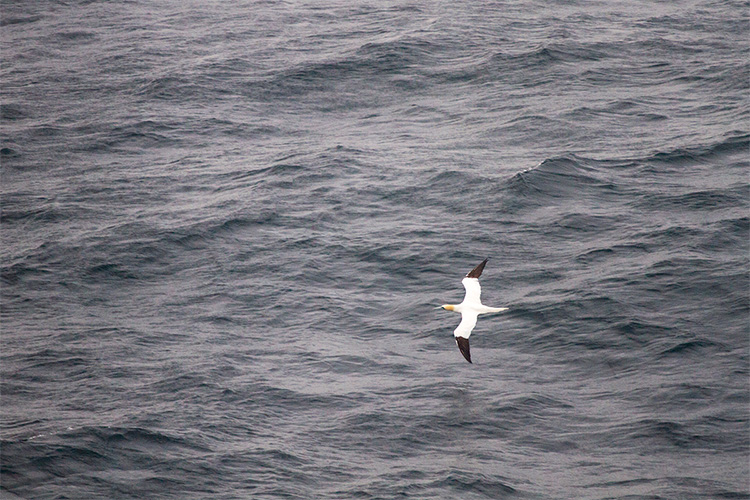
Northern gannet (Morus bassanus) with characteristic yellow head and black wing tips.
Through the spring and summer months, we keep one eye on the horizon in the hope of spotting the diving white flashes of gannets searching for food in the bay in the hope that we can point them out to you during our trips and sessions. We hope that the northern gannet population can bounce back from the last weave of bird flu quickly, and that initiatives such as the “scarecrows of the sea” can help to protect them and allow these magnificent seabirds to flourish.