Fact File: Blue-Rayed Limpet (Patella pellucida)
Most beach-goers are familiar with limpets – the round, ridged, conical grey or beige shells that are stuck all over the rocks as the tide goes out. But not many people know about or ever see their beautiful little relative, the blue-rayed limpet.
Named for the striking aqua-blue dashed stripes that run along the length of its small amber or translucent shell, these marine gastropod molluscs only grow up to about a centimetre and a half (15mm) in length when fully grown and can be found in the shallow waters off the coast of Western Europe, from Iceland all the way down to Portugal, with the exception of the southern end of the North Sea and Baltic coasts.

Blue-rayed limpets are often about the size of a grain of rice

A forest of kelp just beneath the surface
The blue-rayed limpet lives its entire life on kelp, the large leathery brown seaweed that grows in shallow coastal waters but that isn’t often uncovered except for on very low tides, such as the spring tides that we just had with the super blue moon at the end of August. The limpet larvae settle on the kelp fronds and feed on it, leaving tiny little dips and depressions where they’ve been nibbling away. As they develop and grow they move down the kelp, particularly during the autumn so that if stormy seas damage and break off the ends of the kelp frond they won’t be lost at sea. Their final destination as they move down the frond and stipe is the holdfast, the lumpy foot or root of the kelp where it anchors itself to the rock. When the blue-rayed limpet has reached the holdfast it sets to work eating out a protective hollow to live in, the great irony being that in doing so the blue-rayed limpet will often damage and weaken the holdfast to the extent that it breaks and the kelp is washed away.
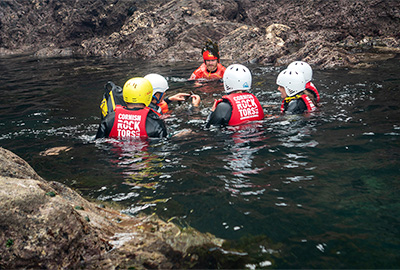
Looking at low tide…
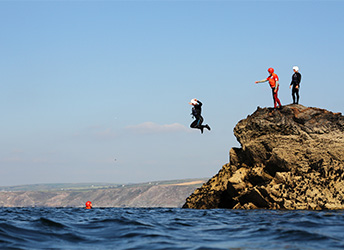
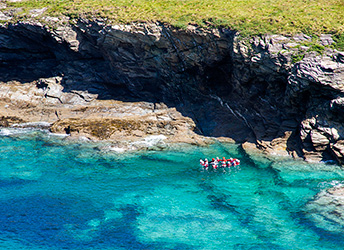
It’s therefore possible to find blue-rayed limpets on kelp fronds that have been washed up on the beach, but we often see them whilst coasteering during low tides when we are moving through their habitat – they can be found from around the mean low water mark down to about 25 or 30 metres deep so we obviously only ever see the top-most ones! We find them quite often, but because they’re so small you have to look closely, and that’s why most people don’t ever realise that they’re there. Once you see and show people those incredible iridescent blue stripes though, you realise just what amazing life forms exist in our rock pools and intertidal zone.
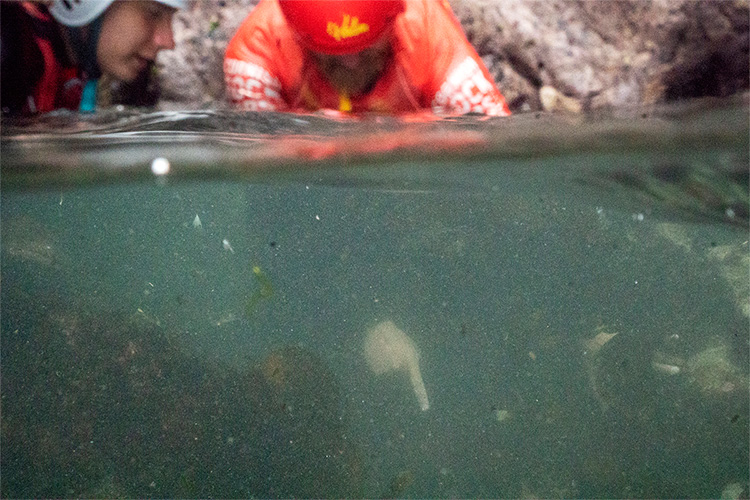
Seek and ye shall find
Come Coasteering with us to see what you might discover in this incredible environment.